Last updated November 18, 2026


Free written scope consultation - allowances, timeline, and change-order rules on paper before a single trade is scheduled
Driveway & Pavers Troubleshooting: Common Problems and How to Fix Them
A single rocking paver that costs $12 to replace can signal a $4,000 base failure underneath. That is the most expensive misunderstanding in residential hardscape: the paver itself is the check engine light, not the engine. In our experience across Fullerton driveways, the units homeowners want to swap out are almost never the actual problem. The problem lives eight inches down, in the aggregate base that was supposed to stay compacted and dry. This guide walks through a real diagnostic sequence – probe tests, joint readings, moisture mapping – so you can tell a base failure from a bedding failure from a unit failure before you spend a dollar. You’ll leave knowing what each repair tier costs and what you can honestly fix yourself.
Quick Answer
Most driveway paver problems trace back to one of three failures: a settling base, a washed-out bedding sand layer, or damaged units – and the surface symptom rarely tells you which. Re-sanding joints runs roughly $0.50 to $1.50 per square foot, re-setting individual units $8 to $15 per unit, a partial base rebuild $12 to $18 per square foot, and a full base replacement typically sits above that. The probe test below tells you which tier you’re actually in before anyone quotes a number.
Styles & brands we work with
- Kitchen remodeling
- Bathroom remodeling
- Home additions & ADU
- Roofing
- Windows & doors
- Driveway & pavers
- Fence
Table of Contents
- The Three Failure Points: Base, Bedding, or Unit
- The Probe Test: Mapping Subsidence Depth
- The Decision Tree: Which Repair Tier Are You In?
- What Each Repair Category Actually Costs
- What You Can Fix Yourself and What You Can’t
- How to Document the Problem Before You Call
- Fullerton Specifics: Climate, Soil, and Drainage
- Common Mistakes to Avoid
- When to Call a Professional
The Three Failure Points: Base, Bedding, or Unit
Every paver driveway is a three-layer sandwich. On top sit the units themselves – the Belgard or Techo-Bloc pavers you see. Below them is a bedding layer, usually one inch of coarse sand, that lets the units sit level. Below that is the base: four to twelve inches of graded, compacted aggregate that carries the load. When something goes wrong, the failure started in one of those three layers, and each one fails differently.
Base failure shows up as broad, spreading movement – a whole field of pavers that has begun to slope, dip, or rock in a cluster rather than a single unit. Water is the usual culprit: an aging base that wasn’t compacted to spec, or that has been infiltrated by fine soil particles, loses its structural integrity and the pavement above it settles unevenly.
Bedding failure is more localized. Sand migrates out of joints during heavy rain, or compacts and creates voids under isolated units. You’ll see joint washout (bare aggregate showing between pavers), individual units rocking slightly, and a pattern that appears after the rainy season rather than gradually over years.
Unit failure is the rarest and cheapest to fix. A cracked or chipped paver, or a paver dislodged by a vehicle turning sharply, is a unit issue. So is efflorescence – the white mineral bloom that some homeowners mistake for damage. It’s cosmetic and clears with the right treatment.
The diagnostic question is always: does the movement follow a single unit, or does it spread across a field? Movement across a field means the base or bedding is involved. In Fullerton, we see bedding failures cluster after the first substantial rain of the season, and base failures show up as slow, spread-out settlement over two or three years.
The Probe Test: Mapping Subsidence Depth
Before you call anyone for a quote, run the probe test. It takes about thirty minutes and gives you data you can compare across multiple bids – which is the single most useful thing you can do.
- Choose three or four test units. Pick the unit that rocks most obviously, plus two or three neighbors in the affected area. Note their position relative to the driveway’s edge, center, and any slope.
- Lift the unit carefully. Use a stiff putty knife or a flat pry bar at the joint edge. Work slowly; you’re trying to lift one paver, not lever the field up.
- Probe the bedding layer. Push a long, thin screwdriver straight down through the sand until you feel firm resistance. Measure the depth from the top of the sand to that resistance with a ruler. One inch is normal. Two to three inches means the sand has compacted or washed out – a bedding failure.
- Probe the base below the sand. Mark the screwdriver at the sand level, then push through the sand into the base. Measure how far the blade sinks before it hits solid resistance. Anything over half an inch of sink means the base underneath that unit is loose or voided.
- Check the level. Place a 4-foot spirit level across the affected units in two directions. A slope of more than a quarter inch per foot toward the driveway’s edge is acceptable; a slope toward the house, a dip in the middle, or a change in slope across the field suggests base settlement.
- Map the moisture. After a dry spell, press a paper towel into the joint. If it comes up damp where the rest of the driveway is dry, water is pooling under those units – possibly an underdrain or grading issue.
Write all six measurements down for each test unit. That sheet is your diagnostic record, and it’s exactly the kind of evidence that lets you compare what different contractors tell you.
The Decision Tree: Which Repair Tier Are You In?
Once you have probe data, the tier becomes clear. Run the tests through this sequence:
- Does the unit rock, but the sand probe hits firm resistance at one inch, and the level is flat? That’s a unit failure – likely a dislodged or damaged paver. Re-set the single unit.
- Do joints show bare aggregate, the sand probe sinks two to three inches, but the level is flat and the base probe holds firm? That’s a bedding failure. Re-sand the joints and re-set any loose units.
- Do you see a cluster of units that have settled below the surrounding field, the base probe sinks more than half an inch, and the level shows a dip or a slope change? That’s a partial base failure. Plan a base rebuild of the affected zone.
- Does the movement cover more than roughly a third of the driveway, with multiple slope changes and widespread softness in the base? Does the driveway drain toward the house instead of away? That’s a full base failure. Replacement is usually the honest answer.
One more signal: if a paver rocks when you step on it and then settles back down, the unit is loose and the bedding has likely failed. If it crunches or sinks further when you step on it, the base is compromised. This distinction matters because the trades are different – re-setting a unit takes minutes; rebuilding the base underneath it takes hours.
We find the decision tree the most useful tool because it separates the paper-and-labor repair (re-sanding, $0.50 to $1.50 per square foot) from the excavation-and-compaction repair ($12 to $18 per square foot). The gap between those tiers is $300 versus $3,000 on a typical 250-square-foot repair zone. That gap is why the diagnosis has to come first.
What Each Repair Category Actually Costs
These are ranges we see in the Fullerton market. They vary with the paver type, the access, and the amount of demolition involved, but the structure is consistent.
| Repair category | What it involves | Typical cost |
|---|---|---|
| Re-sanding joints | Clearing old sand, applying polymeric sand, activating and sweeping | $0.50 – $1.50 per sq ft |
| Re-setting individual units | Lifting, screening fresh bedding sand, re-laying, re-sanding | $8 – $15 per unit |
| Partial base rebuild | Removing failed zone, re-excavating, graded aggregate, compaction, re-lay pavers | $12 – $18 per sq ft |
| Full base replacement | Full demolition, excavation, new base to spec, edge restraints, full re-lay | Above $18 per sq ft; typically bid per project |
Two notes on how we build a quote. First, a written price before any work starts is non-negotiable for us – Clause 1 of the Haven Standard exists precisely so a homeowner knows the flat number, the scope, and the warranty before a tool is picked up. Second, the “full base replacement” line is not something we put a per-square-foot number on in a guide, because the variable is drainage and edge condition, not just area. A 400-square-foot driveway on a slope with a missing edge restraint can cost more than a 600-square-foot driveway on flat ground with intact restraints. Any honest bid will probe and measure before quoting that tier.
If you have a competitor’s written quote in hand, Rowan reviews it line by line at no charge – the Free Second Opinion. That said, the point of that review isn’t to undercut a price; it’s to check whether the scope includes the items that fail to hold. A partial base rebuild that skips the edge restraint is going to creep again; a re-sand that skips the cleaning step won’t hold polymeric sand.
What You Can Fix Yourself and What You Can’t
Some paver repairs are honestly within reach of a homeowner with a Saturday and a stiff putty knife. Others look simple and aren’t.
Genuinely doable: re-setting a single dislodged unit; re-sanding joints with polymeric sand; treating efflorescence with a paver-specific cleaner (muriatic acid is often recommended and almost as often the wrong tool for the surface – check the manufacturer’s guidance first); replacing one chipped paver with an identical unit sourced from a leftover pallet.
Not homeowner-repairable, for practical reasons as much as skill reasons:
- Partial base rebuild. A correct base layer uses graded aggregate with a specified crushed-stone gradation, placed in lifts of about four inches and compacted to density with a plate compactor or vibratory roller. Most homeowners cannot source the right blend, and a hand tamper does not reach the density spec. Half-compacted base fails in a single season.
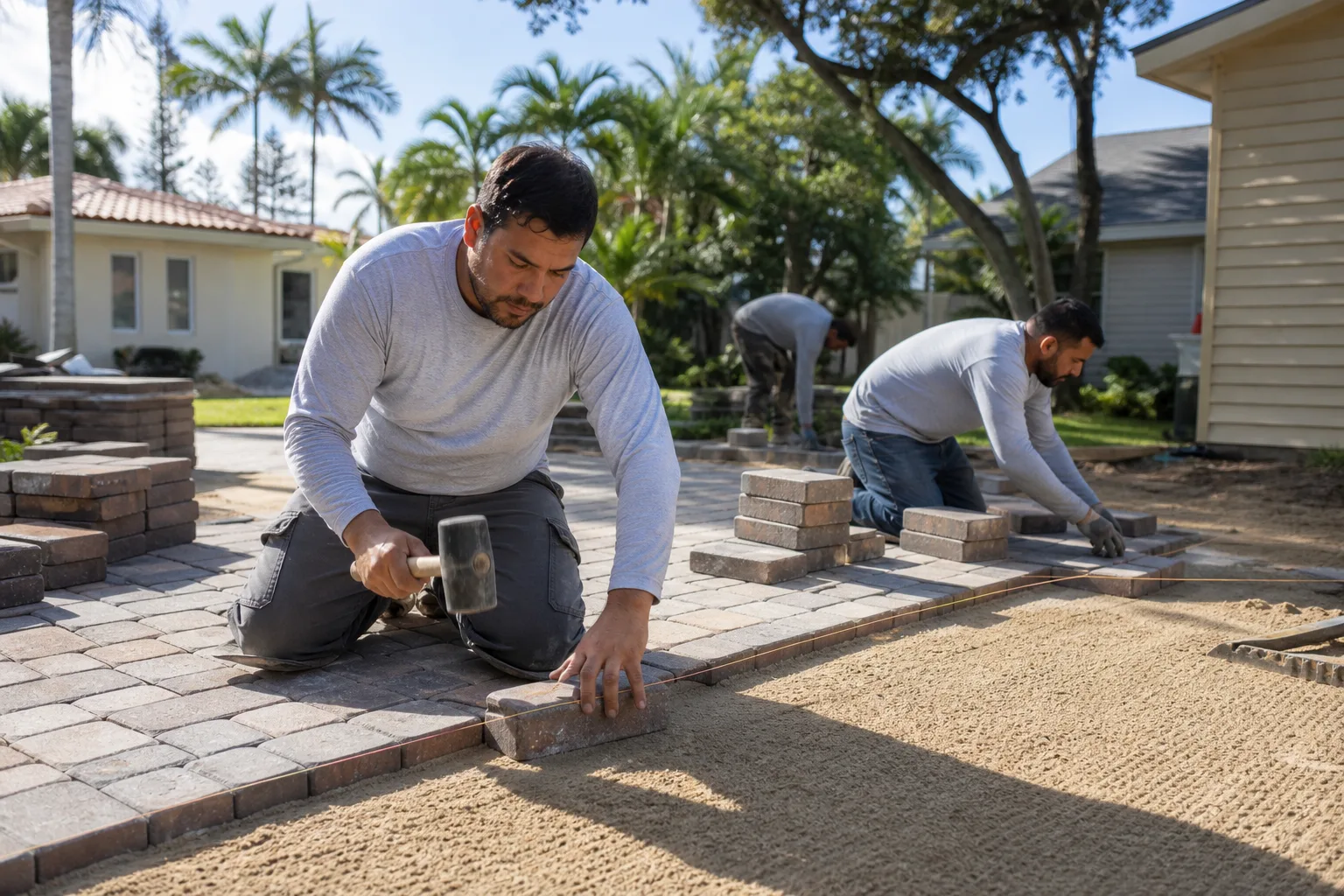
- Edge restraint reinstallation. The border restraint is what holds the entire field from creeping outward. It requires a spiked, pinned, or mortar-set installation at the correct depth, and getting it wrong is the reason pavers splay at the driveway apron.
- Any repair where the affected zone reaches within a foot of the foundation or a garage door sill. This is where water management becomes structural. In Fullerton, where the rainy season can be concentrated, getting the grading wrong at the foundation edge moves the problem from pavement to slab, and the ticket goes from four figures to five.
If the probe test put you in the first tier – re-sand or re-set a single unit – go for it. If you’re in the second or third, the diagnosis is the part worth paying for, because a base rebuild done by hand is a redo waiting to happen.
How to Document the Problem Before You Call
Homeowners who arrive at a bid meeting with a document set consistently get more consistent quotes. Here’s what to collect:
- Photos. One wide shot of the whole driveway showing where the problem sits relative to the house, the garage, and the street. One medium shot of the affected field. Close-ups of every joint that is washed out, every unit that rocks or cracks, and any white powdery bloom.
- Probe measurements. The six data points from the probe test, one row per test unit. Note the sand depth and the base sink measurement for each.
- The level reading. Place a long level across the affected area in two directions and photograph the bubble. A bubble clearly off-center is worth a thousand words.
- Moisture notes. When the driveway was last wet, whether water puddles at the edges, and whether the problem is worse after rain.
- The driveway’s age and install history. If you have the original contract or know the installer, include it. The base spec used at installation tells the contractor whether the failure is a spec issue or an age issue.
- Any prior repairs. A driveway that’s been re-sanded twice in three years is telling the contractor something different than a driveway that’s never been touched.
Why does this matter? Because when three contractors look at the same rocking paver and give you three different diagnoses, you need a shared baseline to compare against. That sheet is the baseline. It also flushes out the bids that are guessing: a contractor who walks the driveway and quotes without probing is quoting a story, not a scope.
Fullerton Specifics: Climate, Soil, and Drainage
Fullerton sits in a climate band where the dry-season-to-wet-season swing is the main driver of paver failure. The soil is largely clay-rich, and clay does not drain. Water that enters the base during the winter rains moves slowly, and when it freezes and thaws in the cooler inland nights, the base expands and contracts. That expansion is what turns a hairline washout into a settled field.
We see this most often in foothill-adjacent neighborhoods and older residential blocks where the driveways slope toward the garage. The fix in those cases is rarely just pavers – it’s re-grading, checking the edge restraint, and ensuring the water sheet-flows to the street during a storm rather than pooling at the foundation.
Fullerton properties with mature trees also see root heave lift paver fields from underneath. That’s a base failure, but it’s caused by a tree, not the base spec. Diagnosis matters: if a tree root is the cause, re-laying the field without addressing the root just defers the same repair a year or two.
And one local note: driveway replacement or significant hardscape work in Fullerton generally requires checking with the city’s building department on grading and any required permits. We pull the permits and pass the inspections as part of the scope – a written price that skips the permit line isn’t a written price. The local pro is licensed and insured as California requires, and every visit includes a documented photo record, so you have the evidence of what was found and what was done.
Common Mistakes to Avoid
- Replacing a single paver without probing underneath it. The new unit sits on the same failed bedding and fails within a season. Probe first, then decide.
- Re-sanding over a dirty joint. Polymeric sand won’t bond to old sand and organic debris. Cleaning the joint is the whole job; the sand is the easy part.
- Assuming efflorescence is damage. It’s a mineral bloom that clears with the right treatment. Replacing the affected units is spending money on a cosmetic issue.
- Ignoring edge creep. When the border paver starts pushing outward, the field follows. Reinstalling the edge restraint is cheaper than re-laying the field it failed to hold.
- Quoting a base rebuild without checking the grading. In Fullerton’s clay soil, a new base that drains toward the garage fails on the first rainy season. Grading has to be in the scope.
- Accepting a verbal diagnosis. “Looks like the base” is not a diagnosis. Ask for the probe data and a written scope with a written price.
- Comparing bids where the scopes differ. A $3,000 bid and a $4,500 bid that include different edge restraint, drainage, and permit work are not comparable. Line-item review against the same evidence is the only honest comparison.
When to Call a Professional
Call a professional when the probe test lands you in the base-repair tier, when the movement covers more than a few units, when the driveway drains toward the foundation instead of the street, or when you’re within a foot of a garage door sill or house foundation. Also call if prior repairs you or someone else did haven’t held – a repeat failure is the loudest signal that the diagnosis was wrong the first time.
Rowan Construction Group Fullerton offers free estimates in Fullerton that use the same probe test and measurement record described here. And it offers a free second opinion on any written estimate you already have, reviewed line by line against the evidence – the point is to catch the scope item everyone else skipped, before you sign. Estimates are free and a written price is delivered before any work starts.
See the difference
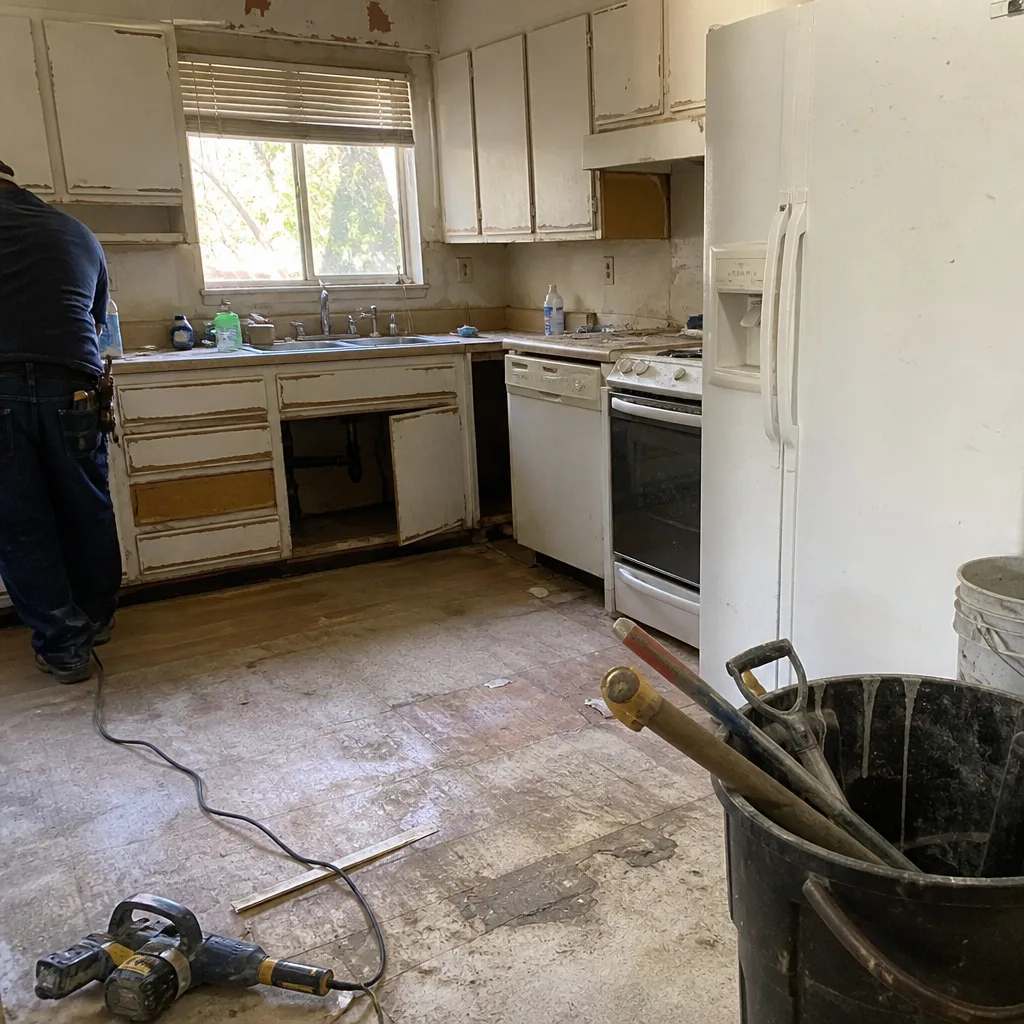 Before
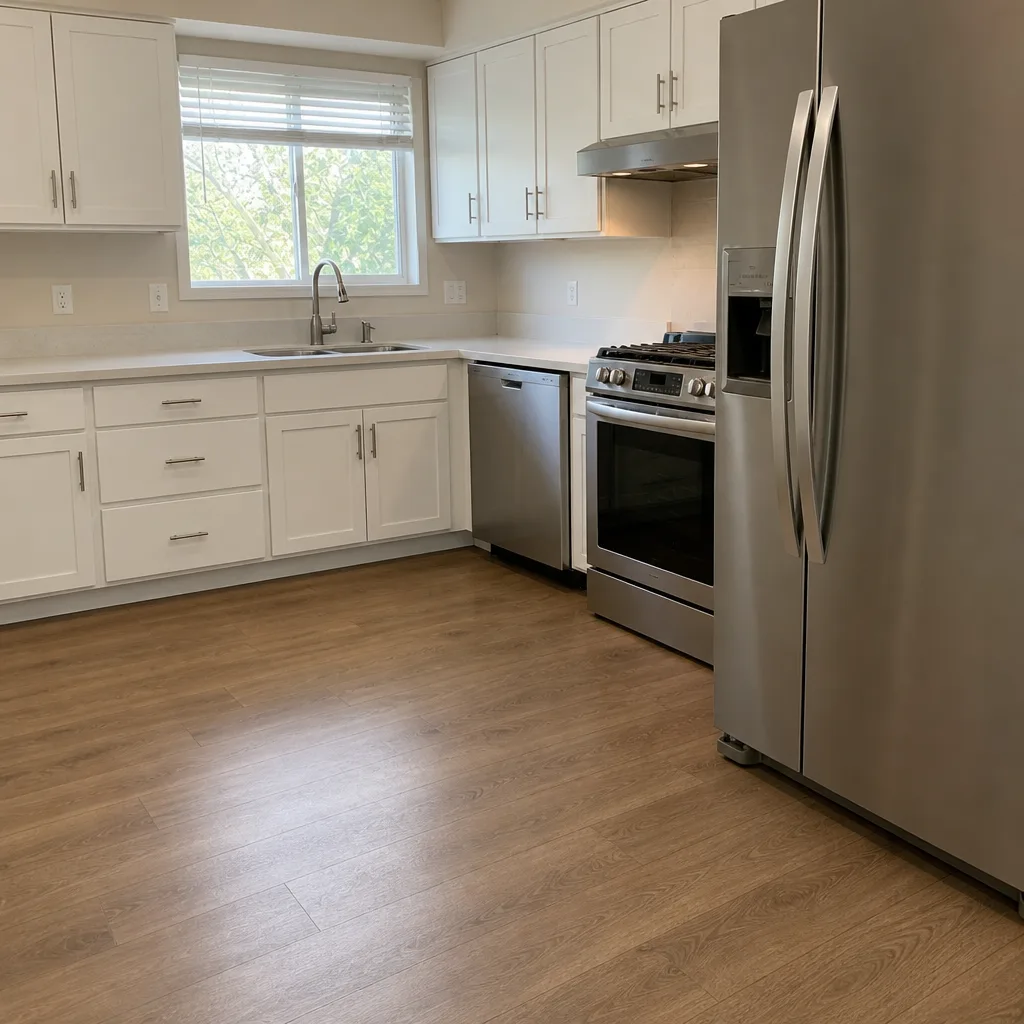 After
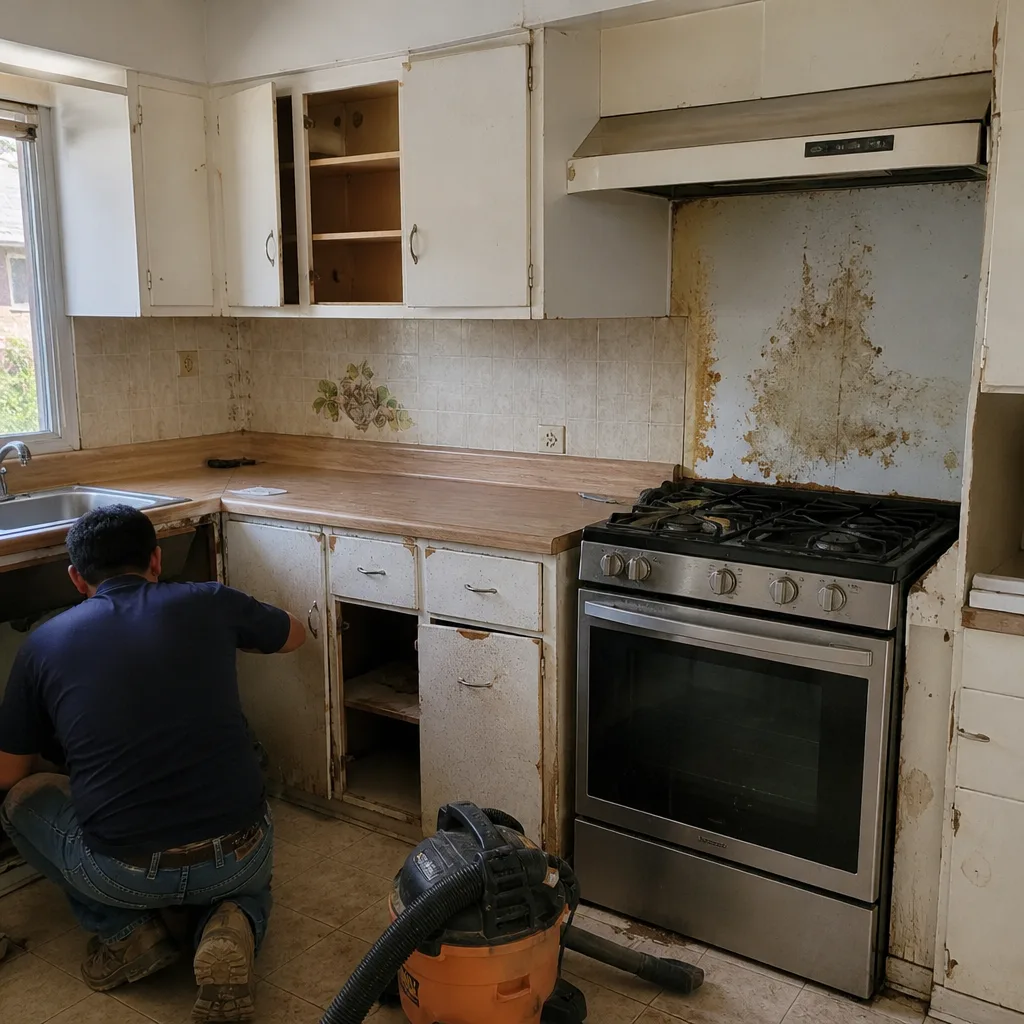 Before
 After
 Before
 After
Frequently Asked Questions
In Fullerton, re-sanding joints runs about $0.50 to $1.50 per square foot, re-setting individual units $8 to $15 per unit, a partial base rebuild $12 to $18 per square foot, and a full base replacement above that. The number depends entirely on which tier the probe test puts you in, so any quote without a diagnosis is a guess. Call (844) 320-7095 for a free estimate.
Yes, if the probe test shows flat sand at one inch and firm base underneath – lift, re-set on fresh bedding sand, and re-sand the joint. If the base probe sinks more than half an inch, the rocking paver is sitting on a base failure and a DIY re-set will fail. Call (844) 320-7095 for a free estimate if you’re unsure which tier you’re in.
Joint washout is a bedding or drainage problem, not a paver problem. Sand migrates out when the polymeric sand has lost its bond and water is moving through the joint, which usually means the driveway isn’t draining away from the field. Re-sanding without fixing the drainage repeats the failure. Call (844) 320-7095 for a free estimate that includes grading.
No. Under Clause 1 of the Haven Standard, the price is written before anyone starts, with a written scope and a written warranty. No work proceeds on a change until a change order is signed. That discipline is why our projects finish within a few percent of the agreed cost. Call (844) 320-7095 for a free estimate.
Yes, for grading and any scope that requires one, we pull the permits and pass the inspections as part of the job. A written quote that skips the permit line isn’t a written quote. Call (844) 320-7095 for a free estimate that includes the permit scope.
A partial base rebuild of a typical affected zone runs a few working days, depending on access, drying time, and the amount of demolition. A full base replacement takes longer and is scheduled during dry weather so the base isn’t compromised by rain. Call (844) 320-7095 for a free estimate with a written schedule.
The Bottom Line
The paver at the surface is a symptom, not the cause. Probe before you repair: the six-measurement probe test takes half an hour and tells you whether you’re in a $0.50-per-square-foot re-sand, an $8-per-unit re-set, or a $12-to-$18-per-square-foot base rebuild. Document the diagnosis before you call anyone, compare bids against the same evidence, and insist on a written price with a written scope before work starts. That’s how a $4,000 base failure gets diagnosed for the cost of a screwdriver and a level – and how it gets fixed once, instead of again next season.
For families in Fullerton planning a repair from re-sand to full replacement, the starting point is the same: a free estimate and a written price before anyone picks up a tool. If you’re planning a broader exterior project, see our work on Driveway & Pavers in Newport Beach, Fence Installation in Newport Beach, and Home Additions & ADU in Newport Beach. And to see how we run every trade, start at the Rowan Construction Group Fullerton home page.
Call Rowan Construction Group Fullerton at (844) 320-7095 for a free estimate in Fullerton. A written price comes before any work starts – that’s Clause 1, on every driveway and every job.
Written by the team at Rowan Construction Group Fullerton.