Last updated November 18, 2026








Free written scope consultation - allowances, timeline, and change-order rules on paper before a single trade is scheduled
Bathroom Remodeling Maintenance Schedule: What to Do and When
Grout sealer applied even two weeks too early can trap moisture in a fresh mortar bed and begin failing within 18 months. That’s not a theory. It’s the failure pattern we see most often when we’re called back to inspect a bathroom that started showing hairline cracks and dark grout lines long before it should have. Most post-remodel care sheets don’t mention an application window at all, which is why the first year after a bathroom remodel matters more than the quality of the install in many cases. This guide gives you a dated calendar for the first 90 days, the first year, and every year after – with product names, inspection criteria, and the specific points where an ignored item turns a $30,000 bathroom into a $12,000 repair. We’re a Fullerton-based contractor, and everything below reflects what we see on coastal Southern California jobs.
Quick Answer
The right bathroom remodel maintenance schedule: inspect everything at day 30, re-caulk as needed at day 60, do a full condition audit at day 90, then reseal grout annually and check exhaust fan CFM every 12 months. The single most important rule is to leave new caulk and sealer alone for the full cure time printed on the tube – usually 24 to 72 hours for silicone, up to 7 days for some sealers – before touching it with water or cleaners. Miss that window and the material fails early, taking the tile and substrate with it over time.
Styles & brands we work with
- Kitchen remodeling
- Bathroom remodeling
- Home additions & ADU
- Roofing
- Windows & doors
- Driveway & pavers
- Fence
Table of Contents
- The First 30 Days After Your Bathroom Remodel
- Days 31 – 60: The Cure Window
- Days 61 – 90: The First Full Inspection
- Coastal Humidity and Your Ventilation Schedule
- Annual Grout and Tile Maintenance by Material
- How to Document Condition at Handoff
- The Cost of Ignoring It: Grout to Substrate Rot
- Maintenance That Voids Manufacturer Warranties If Skipped
The First 30 Days After Your Bathroom Remodel
Days 1 through 30 are the least maintenance and the most observation. Freshly installed tile, grout, and fixtures need to be left alone while they cure, and the homeowner’s job is to look, not scrub. Treat this month as a monitoring period.
Here’s what to actually do:
- Wait the full cure time before first use. Standard cementitious grout needs 24 to 72 hours before water exposure; epoxy grout is faster but still requires the manufacturer’s stated window. Your installer should note the exact product on your handoff sheet.
- Use only a pH-neutral cleaner for the first 30 days. No vinegar, no bleach, no “grout brightener.” These strip the surface layer of fresh grout before it fully hardens.
- Check for standing water after every shower. Water pooling in corners or against a curb means the shower pan slope is off – photograph it, note the date, and report it while the install is fresh.
- Watch the caulk lines weekly. A hairline gap opening at a tub-to-tile or floor-to-wall joint during the first month usually means the joint is still settling – normal movement, not necessarily a defect, but worth recording.
In Fullerton, the biggest first-month risk is not moisture – it’s dry heat. A bathroom finished in late summer can see grout cure too fast if the room is ventilated aggressively with outside air. The grout surface dries before the body of the joint has hardened, and you get powdery or crumbling grout lines in the shower within weeks. Keep the door closed, run the exhaust fan for shorter intervals, and don’t point a box fan at the shower for the first 48 hours.
Days 31 – 60: The Cure Window
This is the window where most homeowners make their first real mistake: they re-caulk or re-seal too early. Silicone caulk at a tub-to-wall joint needs the full manufacturer cure time – typically 24 to 72 hours for standard silicone, but up to 7 days for some high-flex or mold-resistant formulas. Mapei Ultracolor Plus FA grout, a common choice in our Fullerton bathroom remodels, cures fast on the surface but should still be left alone for 72 hours before any sealer goes near it. Apply sealer before that window and you trap residual moisture in the joint, and the sealer breaks down from underneath.
What to do between day 31 and 60:
- Test the exhaust fan. Hold a tissue against the grille with the fan running. If it doesn’t hold the tissue flat, the fan is underperforming or blocked. In a Fullerton bathroom, that means humidity sits in the room after every shower.
- Inspect caulk lines with a flashlight, not your eyes. Run a light along the joint at a low angle. Any gap or shadow line means the caulk has pulled away and needs attention after the full cure window.
- Check the showerhead and faucet aerators. Southern California water runs hard, and the first sign is a white crust on the aerator screen. Remove, soak in white vinegar for an hour, rinse, reinstall – but only if the fixture manufacturer’s instructions allow it (Kohler and Delta both do; Moen sometimes specifies a different cleaner).
- Look for efflorescence – the white powdery deposit on grout lines near the floor. It’s a sign moisture is migrating through the substrate. Log it, don’t scrub it.
We’ve seen more avoided callbacks from this 30-to-60 window than any other part of the schedule. It’s also the window where a homeowner can meaningfully document condition, which matters if a warranty claim is ever needed. For a broader look at how we sequence a bathroom remodel in Fullerton, see our Rowan Construction Group Fullerton home page.
Days 61 – 90: The First Full Inspection
By day 90, everything in the bathroom has seen normal use for 60 days and any latent install issue is now visible. This is the single most valuable maintenance appointment in the first year, and most homeowners skip it.
What the 90-day inspection covers:
- Grout condition. Walk every grout line with a flashlight at a low angle. Cracks, pinholes, or darkened sections matter. Photograph each one with a timestamp.
- Caulk integrity. Press gently on every caulk joint where two planes meet (tub-to-wall, floor-to-wall, shower pan-to-tile). Any give, gap, or discoloration is a flagged item.
- Tile bond. Tap each wall tile with the plastic handle of a screwdriver. A hollow sound indicates a tile that isn’t fully bonded and could detach later.
- Water test the shower pan. Plug the drain, fill 1 to 2 inches deep, leave for 30 minutes, and check the ceiling below (if accessible) and the joints. A slow leak is the expensive kind.
- Ventilation performance. Run the fan for 15 minutes after a hot shower and check for condensation on the mirror and walls. If it’s still fogged, the fan CFM is undersized or the duct is kinked.
- Fixture function. Turn every valve, flush every toilet, test the shower diverter, check the tub drain for slow draining.
Write the results down. The photo and note record you create at day 90 is the baseline that makes any later warranty claim straightforward. A contractor comparing day 90 photos against day 800 photos can see exactly what changed and when. That’s the reason we photograph every visit at Rowan – it’s the same principle applied to the customer’s own records.
Coastal Humidity and Your Ventilation Schedule
Fullerton sits about 15 miles inland from the coast, which puts it in a sweet spot: humid enough to matter, dry enough to create grout-curing issues in summer. Bathrooms in Fullerton see higher average relative humidity than inland Riverside or San Bernardino, and homes built before 1990 often have exhaust fans that were sized for a smaller, less-tiled bathroom than the one now installed. That mismatch is the source of most long-term moisture damage we find on maintenance inspections.
Your annual ventilation schedule:
- Check fan CFM every 12 months. For a bathroom up to 100 square feet, HUD and ASHRAE guidance calls for 50 CFM minimum on intermittent operation. Larger bathrooms need proportionally more. If the fan label reads below that and the bathroom is fully tiled, the fan can’t clear the humidity fast enough.
- Clean the fan grille and impeller every 6 months. Dust on the impeller reduces airflow measurably within a year.
- Inspect the duct in the attic annually. Kinked or disconnected duct in a Fullerton attic is a common find – the fan runs, but the air goes into the attic, not outside.
- Run the fan for 20 minutes after every shower, not 5. The number on the timer is what matters, not the habit. A 20-minute run clears residual moisture that would otherwise condense on grout and caulk overnight.
Coastal humidity also drives a specific failure at the base of exterior walls. Bathrooms on the south or west side of a Fullerton home get more heat gain and more humidity cycling than a north-side bathroom. If your bathroom is on an exterior wall, plan on resealing grout every 12 to 18 months rather than the standard 2 to 3 years. That’s a Fullerton-specific reality most general maintenance guides don’t address because they’re written for a national average.
Annual Grout and Tile Maintenance by Material
Not every tile needs the same schedule. Reseal intervals depend on the grout line width, the tile porosity, and whether the shower sees daily use.
- Cementitious grout with 1/8-inch or wider lines: reseal every 12 months if it’s a shower floor, every 24 months on walls. Full-porcelain tile grout can stretch to 24 months on walls; natural stone surrounds need 12.
- Epoxy grout: reseal every 3 to 5 years – the material is less porous, but it still needs periodic sealer to stay clean.
- Natural stone tile (travertine, marble): schedule sealer every 6 to 12 months. Stone is more porous and more reactive to hard water than ceramic or porcelain. If you have travertine in a Fullerton shower, expect to reseal at least annually.
- Unglazed porcelain tile: reseal every 12 months on shower floor and every 24 months on walls.
For a line-item cost baseline on the tile and fixture selection itself, our Home Additions & ADU in Newport Beach page includes the same written pricing structure we use on Fullerton projects, because material and labor ranges don’t shift much between the two markets.
Hard water in Fullerton also drives a specific maintenance item most guides miss: showerhead mineral buildup. Southern California water averages roughly 8 to 12 grains per gallon of hardness. Depending on your municipal source, the showerhead can start scaling in 3 to 6 months. Clean it quarterly with white vinegar – remove the head, soak for 30 minutes, rinse, reinstall – unless the manufacturer specifies otherwise. Kohler’s Care and Cleaning guide and Delta’s care documentation both allow white vinegar soaks for chrome and brushed finishes, but Moen specifies a mild soap-and-water clean for some coatings, so check your exact model.
How to Document Condition at Handoff
The single highest-value thing you can do after a bathroom remodel is spend one hour documenting condition on the day the crew hands you the keys. It turns future maintenance from guesswork into a comparison. Here’s the handoff documentation process we walk every customer through:
- Photograph every wall, floor, ceiling, and fixture in even light with a phone camera. Timestamps on. Take one wide shot and one close-up of each joint, each shower corner, and each caulk line.
- Write a baseline grout color record. Note the manufacturer and color code of the grout in a document – Mapei Ultracolor Plus FA in “Avalanche” or “Warm Gray,” for example – and photograph a color chip next to the actual grout. Grout darkens naturally with age, and without a baseline, you can’t tell whether the change is cosmetic or a moisture problem.
- Write a caulk baseline. Note the brand, color, and applied date for every caulk joint. Photograph the tube label. If the installer used a specific silicone, that’s the only product you should re-apply when the time comes.
- Record fixture model numbers. Write down the model and serial number of every faucet, valve, and drain assembly. It’s what the manufacturer needs for a warranty claim and what your contractor needs to match a replacement.
- Note the grout sealer application date and product. If the installer sealed it on day 3, that date is your baseline for the next reseal interval.
- Keep the record in the cloud and on paper. Photos in one location, written notes in another. Homeowners sell houses; a documented bathroom condition record increases resale value nearly as much as the remodel itself.
At Rowan, every visit includes a documented photo record as standard – not an upgrade. That’s the same discipline we recommend homeowners apply to their own records. If you’re comparing contractor estimates, our Fence Installation in Newport Beach page shows the same handoff documentation approach we use on exterior work, since the principle holds across trades.
The Cost of Ignoring It: Grout to Substrate Rot
Bathroom deterioration follows a predictable sequence. Knowing the stages and the dollar cost of each one is the whole reason a dated maintenance schedule beats a “we’ll call someone if something looks wrong” approach.
- Stage 1 – Grout failure. Cracked or missing grout lines, usually at corners and floor edges. Repair cost: $150 to $400 if caught early. Most homeowners ignore it for 12 to 24 months.
- Stage 2 – Moisture intrusion. Water passes the failed grout into the thinset and substrate behind the tile. The first signs are efflorescence, dark grout lines that don’t clean up, and a musty smell. Repair cost: $800 to $2,500 depending on how much tile must be removed to dry the wall.
- Stage 3 – Substrate rot. The gypsum board or cement board behind the tile softens and crumbles. Tile starts to feel loose. Repair cost: $3,500 to $7,000 for a shower wall or tub surround rebuild – the tile, the waterproofing membrane, and the substrate all get replaced.
- Stage 4 – Tile detachment and structural repair. Tiles fall off the wall, and behind them is a rotted frame. Repair cost: $8,000 to $15,000 depending on how far the damage extends, and sometimes into the ceiling of the room below.
The gap between Stage 1 and Stage 4 is usually 4 to 7 years. That’s what a maintenance calendar is for. A $250 grout repair on day 800 prevents a $12,000 rebuild on day 2,500. In Fullerton, we’ve seen the sequence run faster – the humidity and warm temperatures accelerate rot – which is why we recommend an annual inspection rather than biennial for any bathroom over a crawl space.
Maintenance That Voids Manufacturer Warranties If Skipped
Most homeowners know their installer offers a workmanship warranty. Fewer know their fixtures carry a manufacturer warranty that can be voided by skipped maintenance. Here’s where it matters:
- Kohler faucet and valve finishes. Kohler’s finish warranty excludes damage from abrasive cleaners. A skipped routine clean means the finish pits, and the claim gets denied because the owner used a scouring pad. The fix is a monthly wipe with a pH-neutral cleaner – that’s the maintenance task that keeps the warranty alive.
- Delta shower valves and cartridges. Delta’s warranty covers the cartridge, but mineral buildup from hard water that isn’t cleaned periodically can be considered neglect. Flushing and cleaning the cartridge screen annually keeps the claim defensible.
- Moen Posi-Temp valves. Moen’s warranty excludes damage caused by failure to follow installation and maintenance instructions. That includes the annual check of the balancing spool and the aerator clean. Skipping it isn’t just an inconvenience – it’s a warranty liability.
- Grout and tile sealer manufacturers. Companies like Mapei warranty their sealer performance only if the product is applied to a properly cured and prepared grout line, and reapplied at the recommended interval. Skip the annual reapplication and the sealer warranty itself is void.
Each of these warranties is worth hundreds to thousands of dollars if a fixture fails. The maintenance tasks that keep them valid are simple – a quarterly clean and an annual inspection. If you’ve lost your documentation, any licensed contractor doing a maintenance inspection can help reconstruct the record from the fixtures’ model and serial numbers. If you’re thinking about pavers or an exterior project after the bathroom, our Driveway & Pavers in Newport Beach page shows how we apply the same maintained-warranty logic on exterior work.
Common Mistakes to Avoid
- Sealing grout too early. Sealer traps moisture if the grout hasn’t fully cured. Always wait the full manufacturer window – usually 72 hours minimum, some products up to 7 days. This is the single most expensive mistake we see in Fullerton.
- Using vinegar or bleach on fresh grout. Both strip the surface layer. Use pH-neutral cleaner only for the first 30 days, and check the label on every “grout brightener” before it goes near the shower.
- Skipping the 90-day inspection. The first three months are when install defects appear. By month 12, most warranties are past the point where the installer will cover labor without documentation.
- Ignoring the exhaust fan CFM label. A 40 CFM fan in a fully tiled shower is a moisture trap. Fullerton homes built before 1990 routinely have fans sized for a smaller bathroom. Verify the number; don’t assume.
- Re-caulking with the wrong product. Silicone on a joint that should be flexible silicone with the right cure window; siliconized acrylic on a joint that needs pure silicone. The wrong choice fails in 6 months. Photograph the original tube when it’s opened.
- Not writing down the fixture model numbers. A warranty claim without a model and serial number is a hard stop. Write them down at handoff.
- Cleaning with the wrong product for the fixture finish. Kohler chrome and Moen brushed nickel react differently. Using a scouring pad on a Kohler chrome finish voids the finish warranty in a single cleaning.
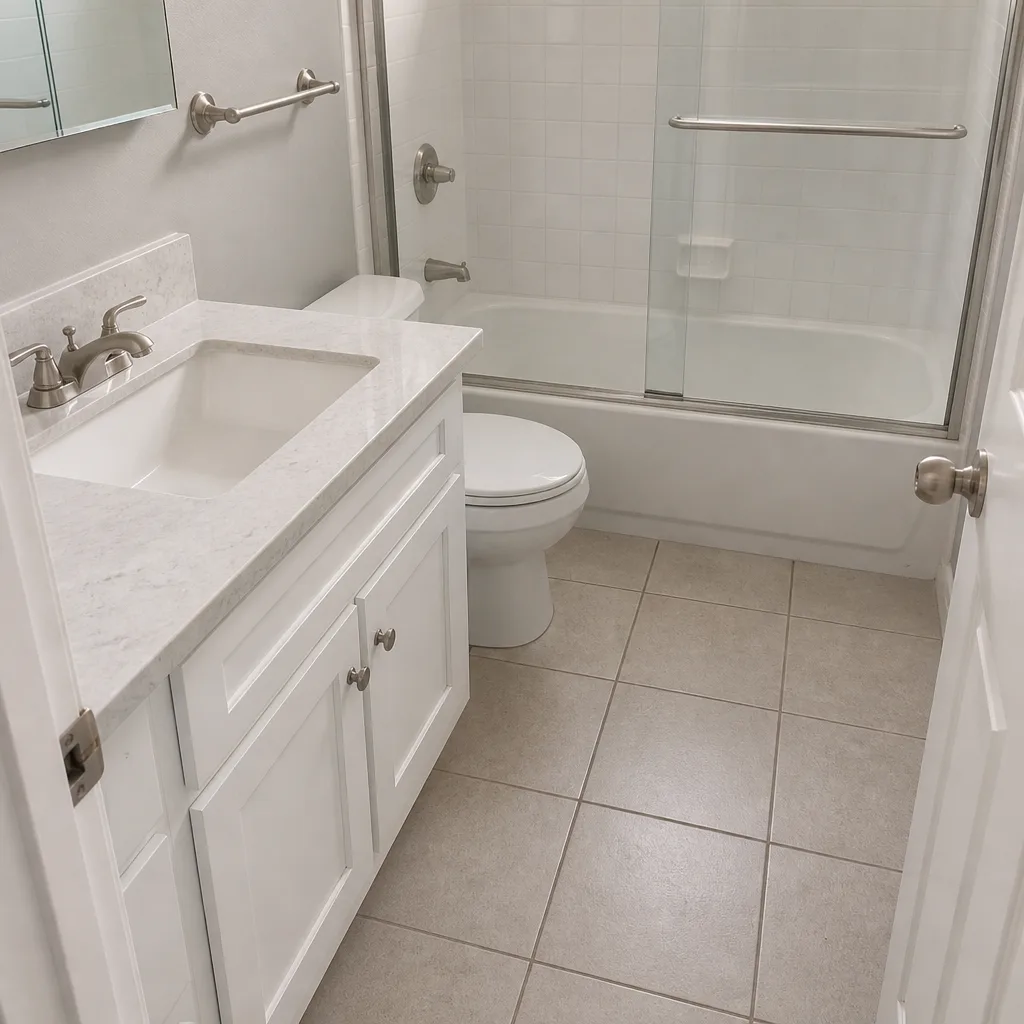
See the difference
 Before
 After
 Before
 After
 Before
 After
When to Call a Professional
Some maintenance is homeowner-level: cleaning the aerator, wiping down fixtures, running the exhaust fan for 20 minutes, photographing a suspicious grout line. Other items need a professional, and calling early saves money. Call us if you see any of the following: standing water in the shower pan after 30 minutes of dry time; a hollow sound when you tap wall tile; visible efflorescence that returns after cleaning; a shower that stays fogged for more than 10 minutes after the exhaust fan stops; caulk that pulls away from the joint within a week of re-application; or any spot in the ceiling below the bathroom that darkens over time. Rowan Construction Group Fullerton offers free estimates in Fullerton – call (844) 320-7095 to schedule a maintenance inspection or a second opinion on any written estimate you’ve already received.
Frequently Asked Questions
Wait at least 72 hours after grout installation, and up to 7 days for some sealers – check the product label. Applying sealer before the grout has fully cured traps residual moisture, and the sealer fails from underneath within 18 months. If your installer didn’t note the seal date, call them and ask; the answer is in their job record.
Every 12 months for shower floor grout, every 24 months for wall grout, and every 6 to 12 months for natural stone tile. Fullerton’s inland-coastal climate drives higher average humidity than most Southern California cities, which cuts 6 to 12 months off the national-average reseal interval. The sooner you reseal after a shower, the shorter the interval.
Check the CFM rating on the fan label against your bathroom square footage: 50 CFM minimum for bathrooms up to 100 square feet, more for larger. If the mirror fogs within 5 minutes of the shower ending, or if you can’t feel airflow with your hand at the grille, the fan or the duct is the problem. A licensed technician can measure actual airflow, not just the label spec.
Yes, in specific cases. Kohler’s finish warranty excludes abrasive cleaners, and Moen’s warranty excludes damage caused by failure to follow maintenance instructions. The maintenance tasks that keep those warranties valid – pH-neutral monthly cleaning, annual cartridge and aerator inspection – are printed in the owner’s manual. Keep the manual with your handoff documentation, and photograph any maintenance you do so a future claim has evidence.
Repeating efflorescence – the white powdery deposit on grout – or dark grout lines that don’t clean up with pH-neutral cleaner. Both mean water is migrating through the grout into the substrate. A hollow sound when you tap wall tiles is the next stage; call a professional at that point, because the repair is already beyond a grout fix.
Do the visual and photo parts yourself – it’s a two-hour project. Call a professional if the water test shows a slow leak, if any tile sounds hollow, if the exhaust fan underperforms, or if efflorescence returns within 30 days of a cleaning. A licensed inspection at 90 days costs a fraction of the Stage 3 substrate repair it can prevent.
The Bottom Line
A bathroom remodel’s real lifespan is set in the first 90 days and then maintained with a simple annual schedule. Inspect at day 30, leave cure windows alone through day 60, do a full condition audit at day 90, then reseal grout annually, check exhaust fan CFM every 12 months, and clean hard-water deposits quarterly. Document the handoff with dated photos and written baseline readings for grout color and caulk joints, so any future warranty claim has evidence rather than memory. In Fullerton, the coastal humidity and warm summers compress the failure timeline, which is exactly why a dated calendar beats a “watch for problems” habit. Maintain what you paid for, and the bathroom lasts decades instead of years.
Rowan Construction Group Fullerton offers written, flat-price estimates before any work starts, free second opinions on any contractor estimate you’ve already received, and a 365-Day Done Right Promise backed by The Haven Standard – not a handshake. Call (844) 320-7095 for a free estimate or maintenance inspection. Our technicians have up to 19 years of experience, every crew member is background-checked and uniformed, and every visit includes a documented photo record as standard. We answer the phone with a live person, 24/7.
Written by the team at Rowan Construction Group Fullerton.